
Last updated September 20, 2026
Full 25-point door and opener safety check with every visit - springs, cables, rollers, tracks, and your LiftMaster or Chamberlain opener included
You get a price before we start. It does not change when the truck arrives.
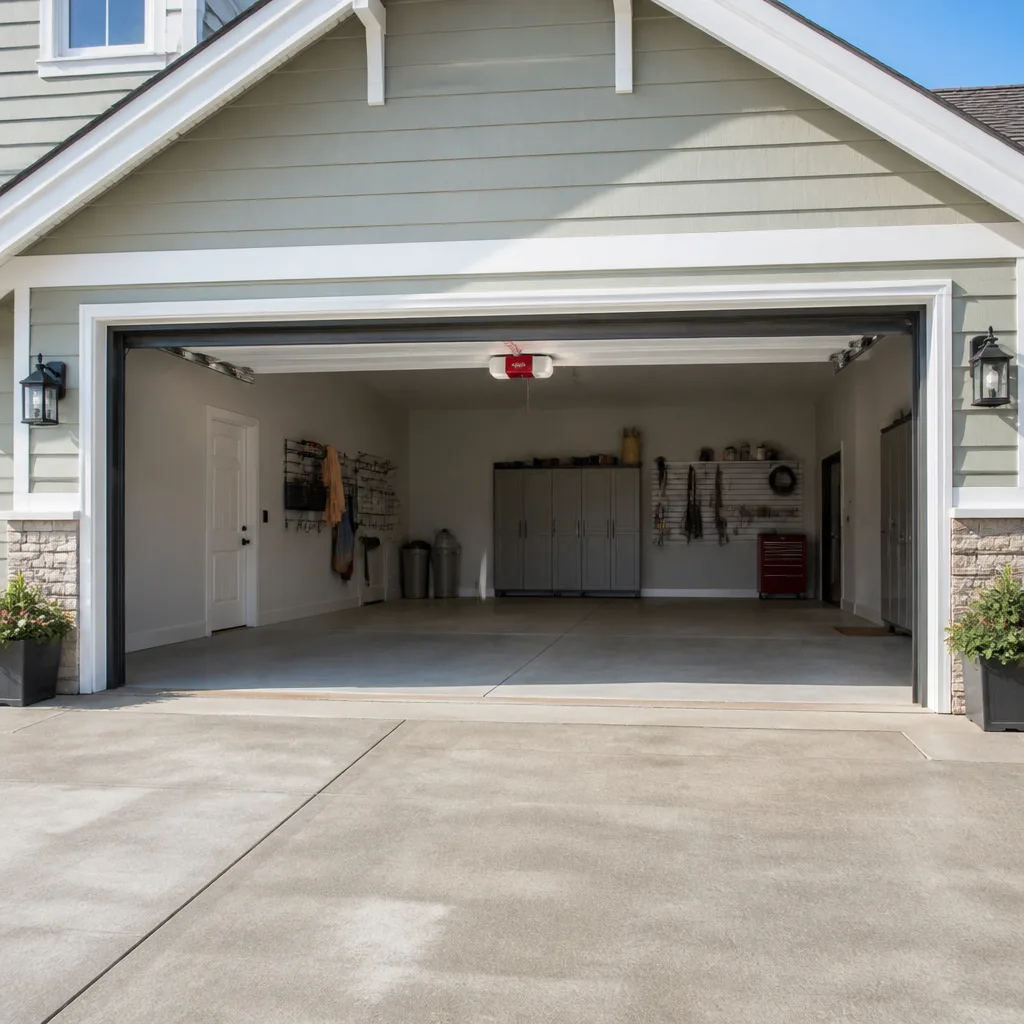
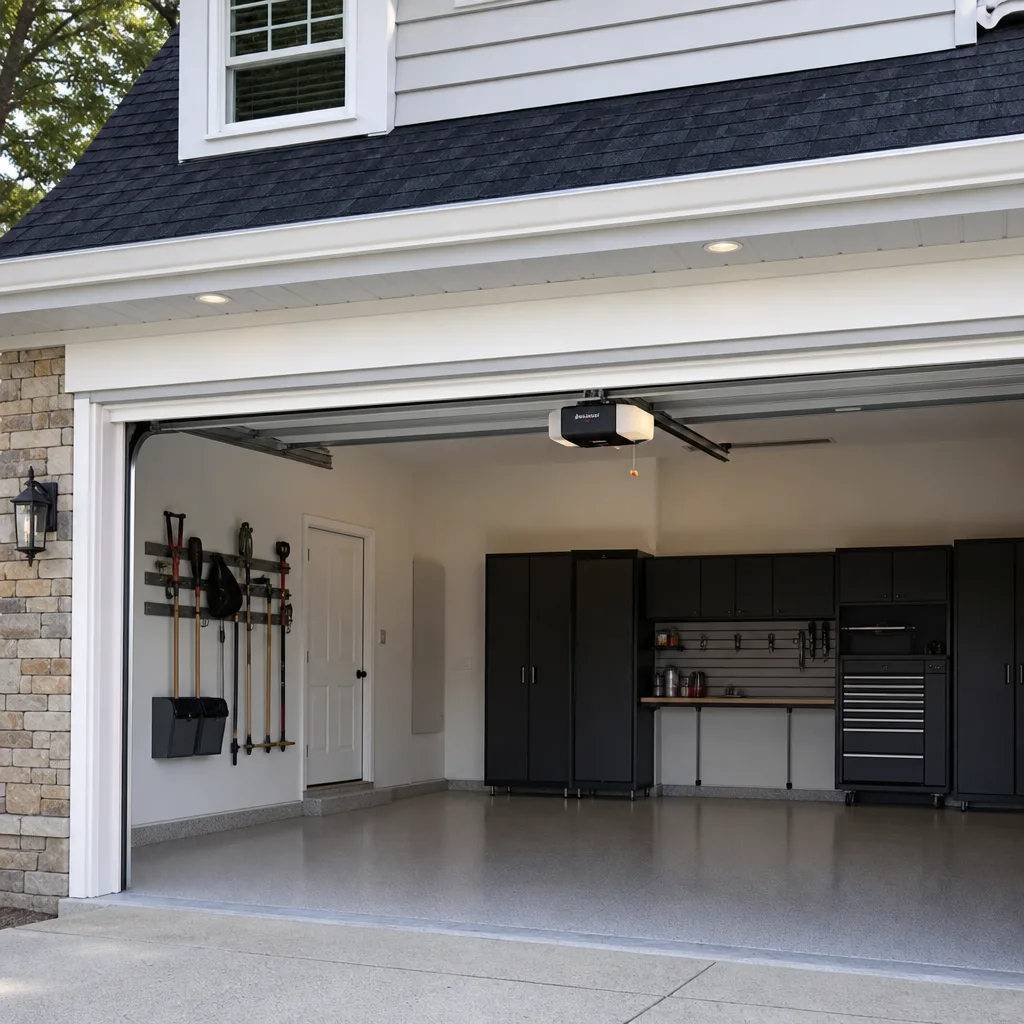
 Before
 After
After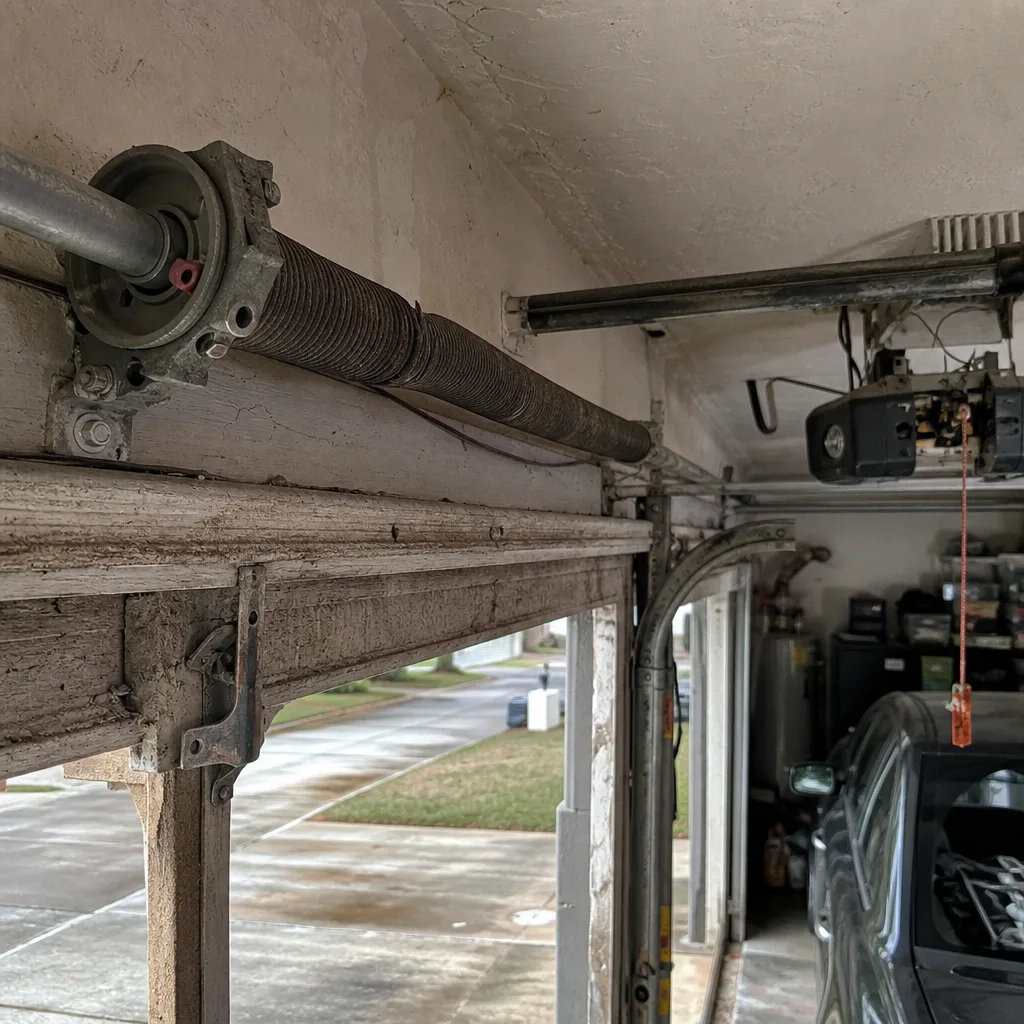 Before
 After
After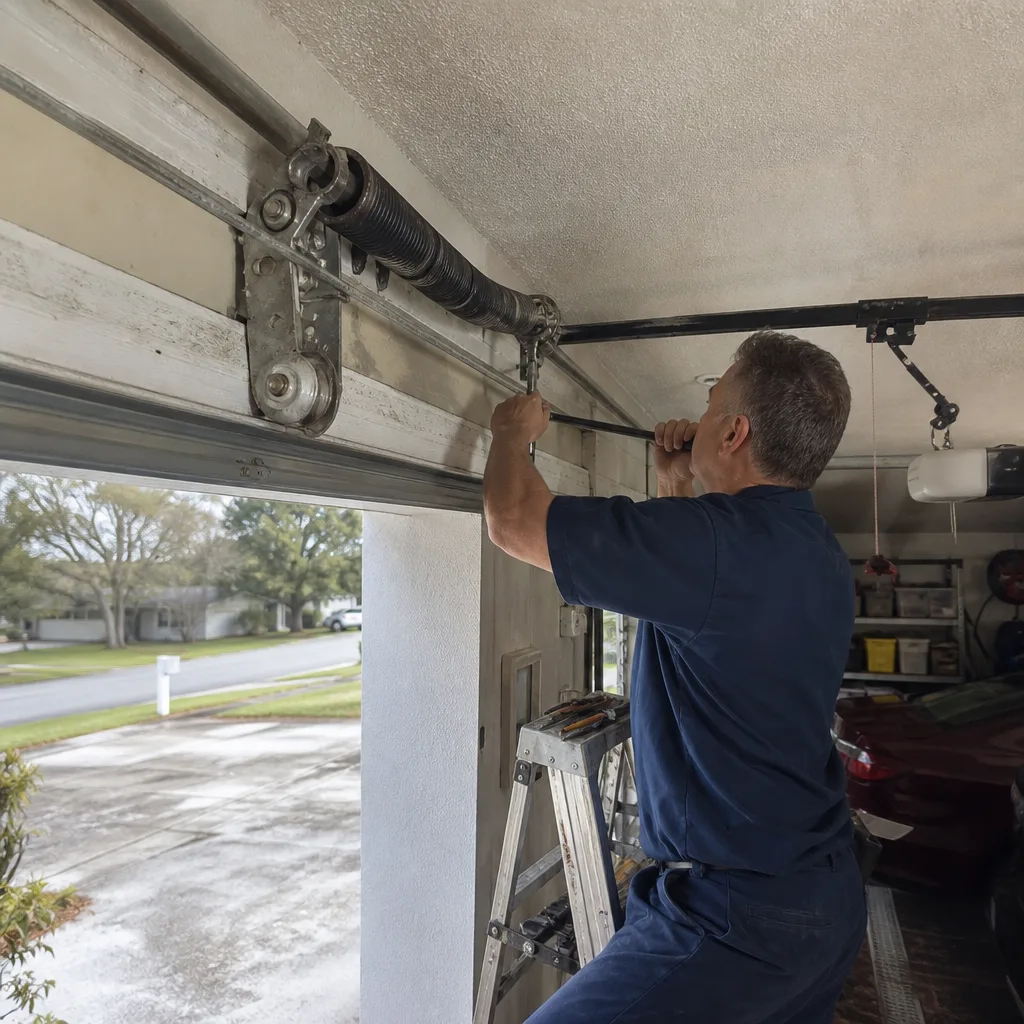 Before
 After
AfterSeasonal Garage Door Care for Tampa: Year-Round Homeowner’s Guide
The garage door component most likely to fail in the 48 hours after a Tampa hurricane isn’t the door panel. It’s the torsion spring. Rapid pressure-drop and re-pressurization cycles cause the spring to work against itself even when the door never opened during the storm. Most homeowners in Tampa don’t discover this until they press the opener button and hear either nothing, or a sound like a rifle shot from inside the garage. This guide maps garage door maintenance to Tampa’s actual stress seasons rather than a generic quarterly calendar, so you can catch failures before they strand you in a driveway at 7 a.m. on a workday.
Quick Answer
Seasonal garage door care in Tampa means aligning maintenance with five weather-driven stress periods, not calendar months: pre-hurricane-season hardware audits (May), post-storm inspections (June through November), the April-May humidity spike for lubrication, summer thermal cycling for track binding, and the dry-season window from November through February for seal and wood contraction checks. A homeowner can handle the visual inspections and lubrication. Spring, cable, and track-bracket work should go to a licensed technician because the stored energy in a torsion spring is enough to cause serious injury.
Table of Contents
- Tampa Has No Winter, But Five Stress Seasons
- Pre-Hurricane Season Hardware Audit: May
- Post-Storm Inspection Sequence: What to Check Before You Press the Button
- The April-May Humidity Window: Lubrication Done Right
- Summer Thermal Expansion: When Your Door Binds Only in the Afternoon
- Dry-Season Contraction: The Seal Gaps That Hide in Winter
- Common Mistakes to Avoid
- When to Call a Professional
- Frequently Asked Questions
- The Bottom Line
 Before
 After
AfterTampa Has No Winter, But Five Stress Seasons
Tampa’s climate doesn’t give garage doors a break. It gives them five different ways to fail. What works for a homeowner in Chicago, where the door faces snow load and sub-zero contraction, has nothing to do with what a door in Carrollwood or Seminole Heights deals with. Our climate cycles are driven by humidity, pressure, and heat, not frost. And each stress season damages a different component.
Here’s what we’ve documented across thousands of service calls in Tampa since 2015:
- Hurricane season load-testing (June through November): Pressure differentials stress springs, cables, and the fasteners holding the track to the wall. This is when set screws loosen and brackets pull out.
- Post-storm debris and wind-driven rain (June through November): Debris gets into tracks and guides. Salt spray from coastal areas accelerates rust on exposed hardware.
- The April-May humidity spike: Relative humidity that stays above 80 percent for weeks changes which lubricants actually work and which ones trap moisture against metal.
- Summer daily thermal cycling (May through October): Metal tracks and aluminum panels expand in afternoon heat. A door that runs fine at 8 a.m. can bind at 3 p.m. This is a tolerance issue, not a defect, and it’s diagnosable.
- The dry-season contraction window (November through February): Lower humidity and cooler nights cause wood doors to shrink and seals to change shape. Gaps that weren’t there in August appear in December.
Mapping your maintenance to these five periods instead of “once per season” is the difference between catching a $120 repair and paying for a $450 emergency call on a Saturday afternoon in August. If you’re new to garage door upkeep in Tampa, start with the audit below. It covers the checks that matter most before storm season.
Pre-Hurricane Season Hardware Audit: May
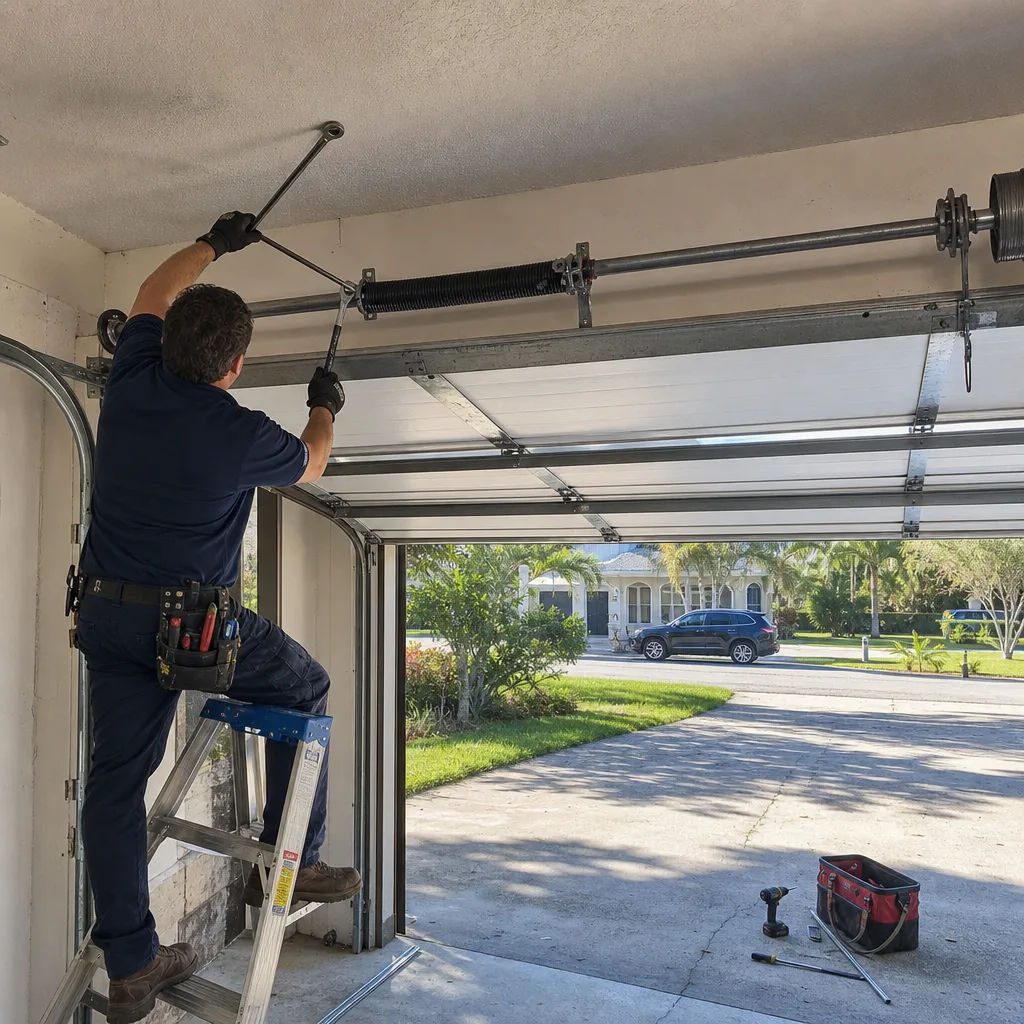
The first named storm of the Atlantic season usually arrives before June. By May 15, we recommend every Tampa homeowner complete a hardware audit. This is not the same as a visual inspection. A visual inspection tells you the door opens. A hardware audit tells you whether the door will stay attached to the building when wind pressure drops and your garage becomes a pressure vessel.
Why the garage matters in a hurricane is straightforward: the garage door is the largest opening in most Tampa homes. If the door fails under wind load, pressure enters the garage and lifts the roof. That’s the structural failure mode that turns a repairable house into a total loss. The hardware audit below focuses on the specific fasteners that fail under storm load but never fail under normal daily use.
What to check, in order:
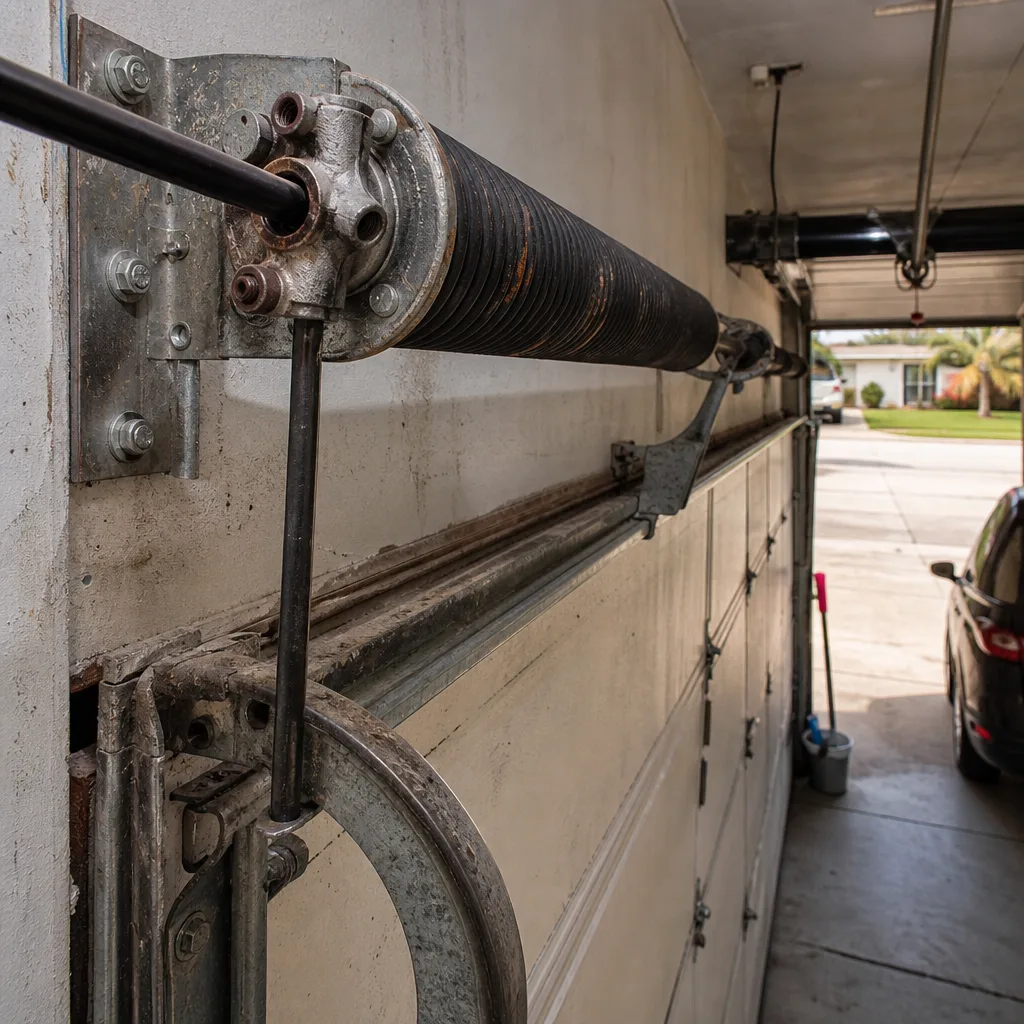
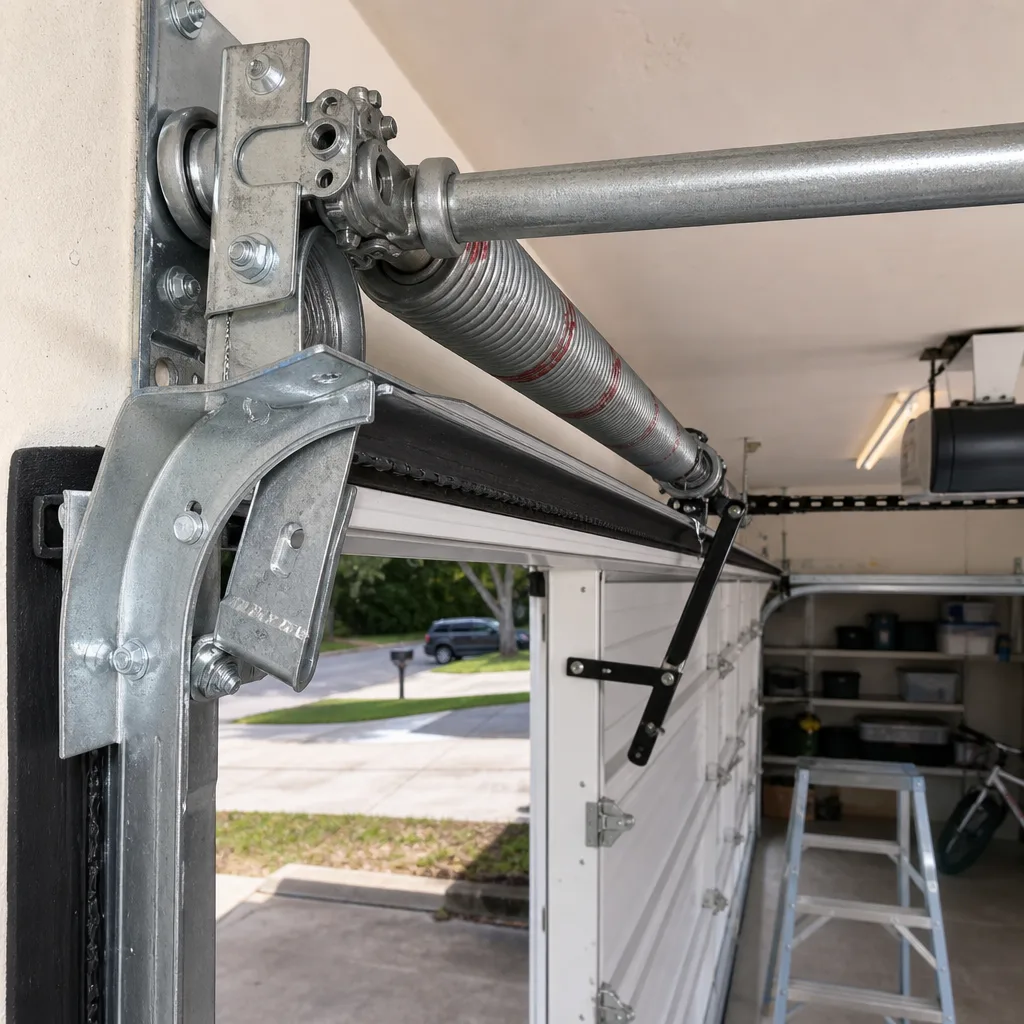
- Spring set screws: The torsion spring above the door is held to the shaft by two square-head set screws. If they’re loose, the spring slips. Under storm pressure, a slipping spring unloads unevenly and can snap. Test by looking for red dust around the collar, which indicates the spring is rotating against the shaft.
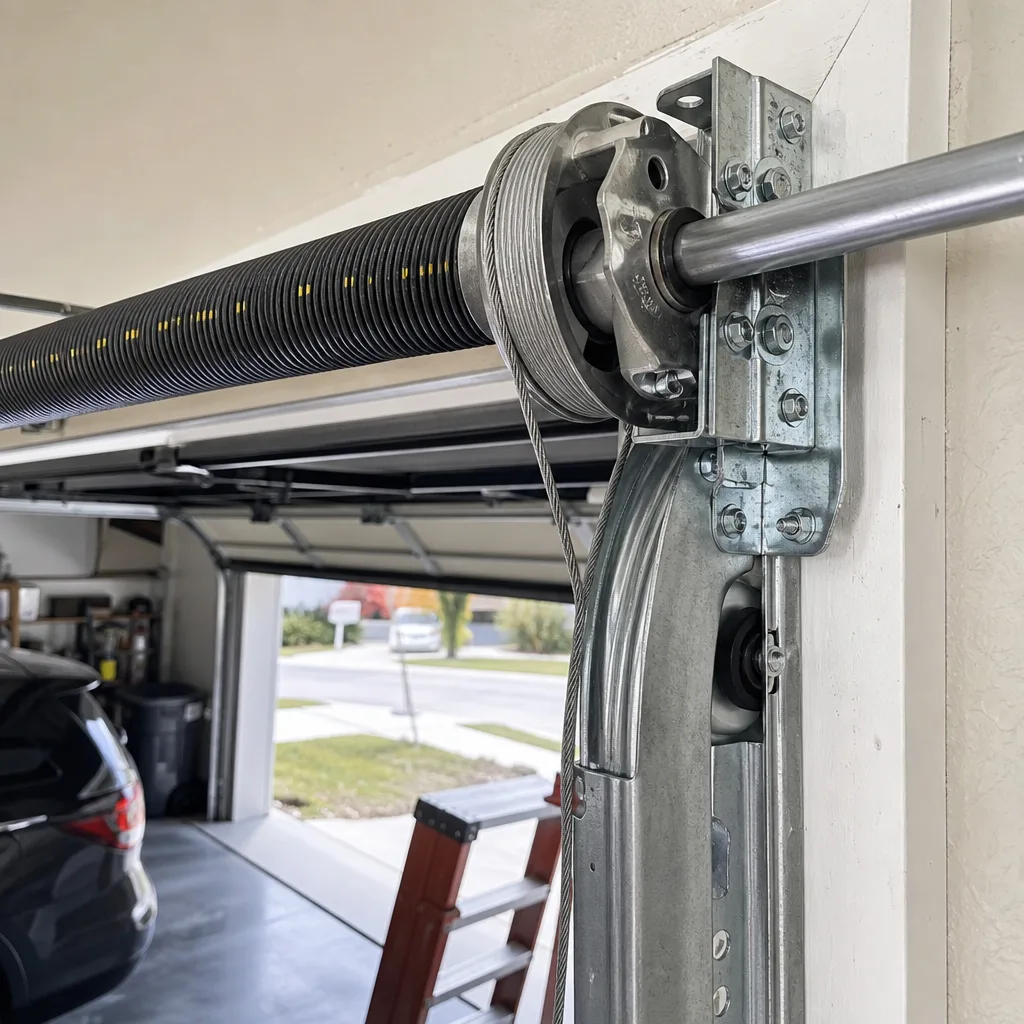
- Cable drum set screws: Each side of the door has a cable drum that winds the lifting cable. The set screws that hold the drum to the shaft work loose over time. A loose drum under load means the cable unwinds on one side and the door lifts crooked, or not at all.
- Track bracket lag bolts: The vertical tracks are bolted into the door frame or jamb with lag bolts. In 20 percent of the pre-storm audits we do in Tampa, at least one lag bolt is either loose or stripped. Wind pressure against a 16-foot door exerts enough force to pull a stripped lag bolt through drywall.
- Bottom seal condition: The rubber seal along the bottom edge is what keeps wind-driven rain from entering under the door. After two summers of Tampa heat, most seals are cracked or flattened. Check for daylight visible under the door when it’s closed.
- Opener emergency release: The red cord hanging from the trolley carriage disconnects the door from the opener. It must be accessible and functional. If the power fails during a storm, you’ll need it to open the door manually.
This audit takes 20 minutes. It doesn’t require touching any component under tension, which is important because torsion springs hold enough stored energy to cause severe injury if mishandled. If any of the checks above reveals a problem, or if you’d rather a technician document it with photos, a proper garage door repair in Tampa covers these checks as part of a full inspection.
Post-Storm Inspection Sequence: What to Check Before You Press the Button
After a hurricane or tropical storm has passed, the urge is to press the opener and see if everything still works. Don’t. The first operation after a storm is when a compromised component gives way. We’ve had Tampa customers report that their door ran fine after Hurricane Idalia, then dropped six feet onto a car three days later when a cable finally failed. Here’s the sequence we recommend before that first operation.
Step 1: Visual panel inspection from inside the garage. Walk the length of the door and look at each panel. Storm debris hits the outside face; the damage you’ll see from inside is a bow or deflection across the panel’s center. Place a straightedge (any flat board over four feet long works) across each panel horizontally. If you see a gap of more than 1/4 inch anywhere between the straightedge and the panel face, the panel has permanent deformation. That deformation changes the panel’s effective height and will bind in the track.
Step 2: Check both lifting cables. The cables run along each side of the door, from the bottom bracket up to the drum. They should be taut and seated in the drum’s groove. A cable that’s slack, frayed, or sitting outside the groove means the door is about to lift unevenly. Do not try to reseat a tension cable by hand.
Step 3: Check track alignment at each roller. With the door closed, look at where each roller sits inside the track. The roller should be centered in the track opening with clearance on both sides. If a roller is pressed hard against one side of the track, the track is out of alignment or a panel is bowed.
Step 4: Test the balance manually. Pull the emergency release cord and lift the door by hand to about waist height. A properly balanced door stays at that height. If it drops, the springs have lost tension. If it’s heavy and hard to lift, you’re lifting most of the door’s weight yourself, which means a spring is broken or stretched.
Step 5: First powered operation with your hand on the stop button. Reconnect the opener and run the door while watching the cables and panels. If you hear grinding, see the door hesitate, or notice one side lifting before the other, stop immediately. Something is binding, and continued operation causes damage.
This sequence catches the two most common post-storm failure modes in Tampa: panel deformation that doesn’t reveal itself until the door reaches the curved section of track, and cable damage that doesn’t snap until the door is under full tension mid-cycle. If anything fails the checks above, the repair is a documented job, not a guess. That’s how professional garage door installation and repair work in Tampa should be done: with the failed component measured, photographed, and replaced against a written scope.
The April-May Humidity Window: Lubrication Done Right
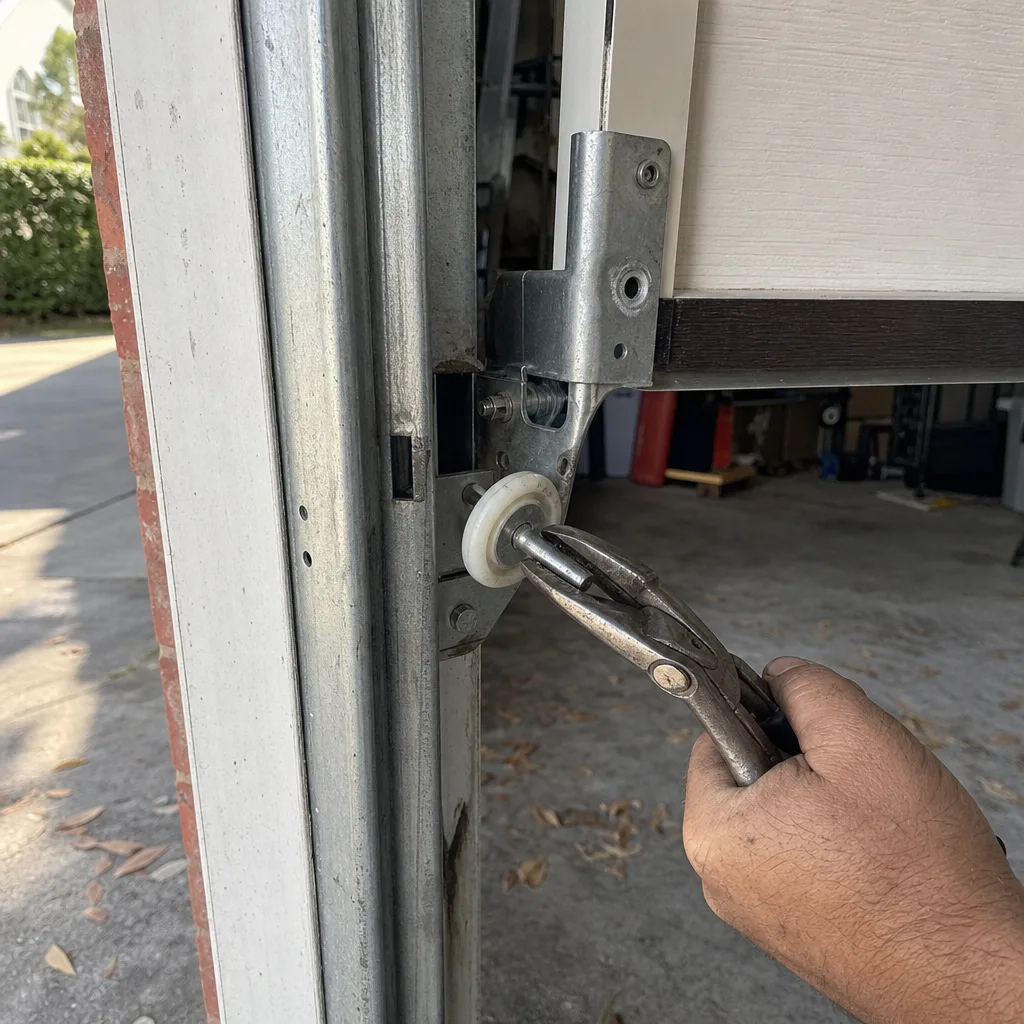
April and May in Tampa are not “spring maintenance season.” They are the weeks when the air holds enough moisture to change what your garage door lubricant actually does. Apply the wrong product in 85 percent humidity and you’re not lubricating. You’re creating a paste that traps moisture against the metal.
Here’s the chemistry, in plain terms. A lubricant’s job is to create a film between moving surfaces so metal doesn’t rub metal. But in Tampa’s April-May humidity window, a heavy grease or a wet-style spray lubricant absorbs airborne moisture. That moisture sits against the hinge, the roller bearing, or the spring coil. The result is a lubricant that still looks slick but is actually holding water against the steel. Corrosion accelerates. The component fails from rust rather than wear.
What actually works in high humidity:
- Dry lithium spray on hinges and roller bearings. It goes on wet and dries to a film that doesn’t attract moisture. Apply a short burst to each hinge pivot point and each roller bearing. Wipe the excess.
- Silicone spray with a straw applicator on the track’s inner surface, applied lightly. Silicone doesn’t build up a grease film that traps Tampa’s airborne salt and grit.
- Garage-door-specific spray lube (the kind sold by LiftMaster and Genie) on the torsion spring coils, not on the track. The spring needs a thin film to prevent coil-on-coil friction, not a heavy coat.
What doesn’t work and why:
- WD-40 or any water-displacing spray used as a lubricant. It’s a solvent, not a lube. It cleans, then evaporates. In Tampa humidity, the cleaned metal surface is more exposed to oxidation than before you sprayed it.
- Heavy axle grease. It’s designed for packed bearings, not open hinges. In high humidity it forms a paste with dust and debris and becomes a grinding compound.
- Motor oil or cooking oil. Motor oil drips onto the weather seal and degrades it. Cooking oil polymerizes (hardens to a varnish) in heat and locks the hinge in place.
Lubrication timing matters as much as the product. In Tampa, the best window is a dry morning in late April or early May, after the last cold front has passed but before the daily 3 p.m. thunderstorms become a pattern. If you lubricate in July, you’re spraying oil into already-wet moving parts. If you wait until November, you’ve missed the window where the film would have protected against four months of peak humidity.
Summer Thermal Expansion: When Your Door Binds Only in the Afternoon
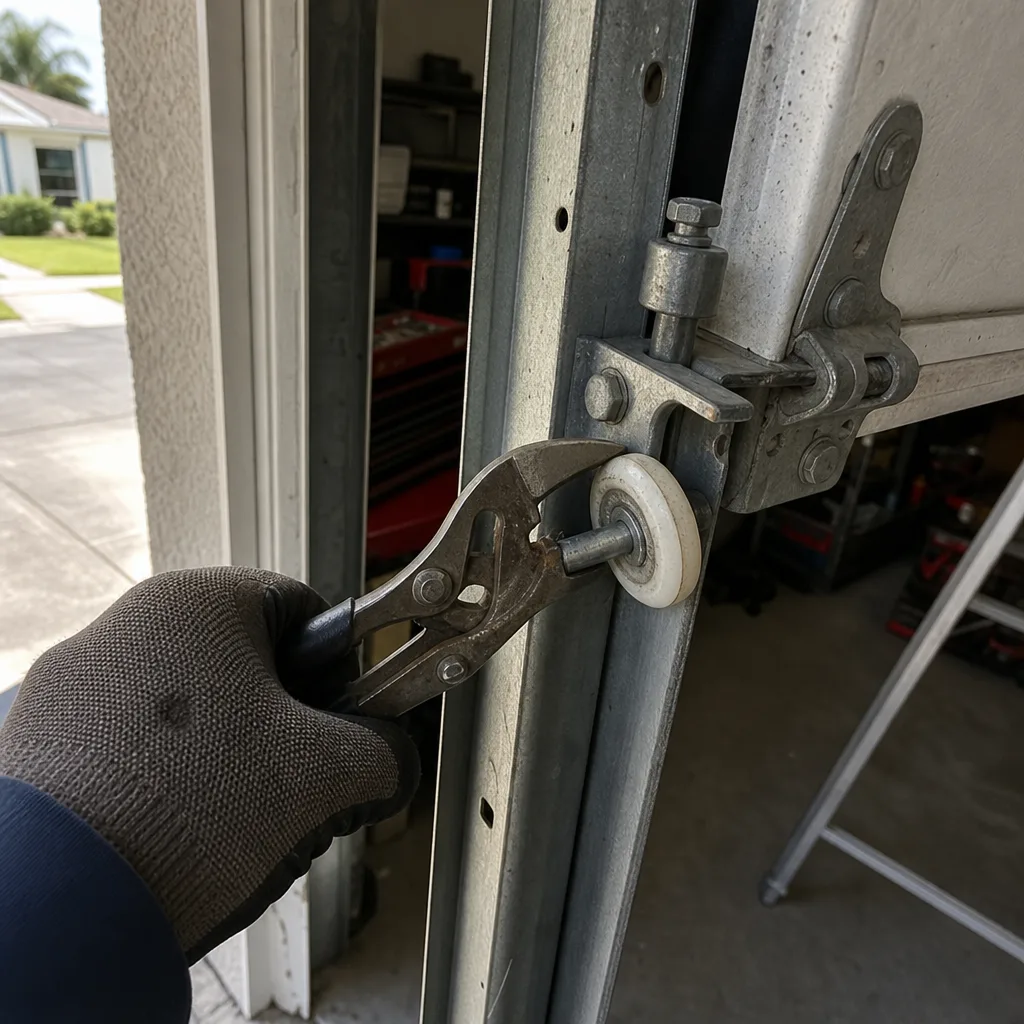
Here’s a scenario we hear from homeowners across Westchase, Brandon, and South Tampa every summer: the door runs fine at 7 a.m., drags or shudders at 2 p.m., and goes back to normal after dark. The homeowner thinks the opener is failing. It’s usually not the opener. It’s thermal expansion, and the diagnosis takes five minutes with a straightedge.
Metal expands when it heats. A 16-foot steel garage door track in Tampa can lengthen by 1/8 to 3/16 of an inch between a 68-degree morning and a 94-degree afternoon. The door itself, if it’s steel or aluminum, expands as well. The result is that clearances that were adequate at 7 a.m. become tight at 2 p.m. A roller that had 1/16 inch of clearance in the morning is now pressed against the track wall. The door drags. The opener works harder. If the customer keeps operating the door through the binding, the roller wears a flat spot, the track starts to wear, and the original binding becomes permanent.
How to identify thermal binding versus structural misalignment:
- Run the door in the morning and check it. Measure the gap between the roller and the track wall on each side using a feeler gauge or a thin ruler. Write it down.
- Run the same check at 2-3 p.m. If the gap on one or more rollers is visibly smaller, and the door shudders or drags, you have thermal binding. The track is parallel, but the door or track has expanded and eaten the clearance.
- Run it again after 7 p.m. If the door runs smoothly and the gaps return to the morning measurements, the issue is thermal by definition.
If the door binds at all times of day, or binds in the morning when it’s cool, that’s not thermal. That’s a track out of alignment, a panel with permanent deformation, or a roller bearing that’s failed. Those need repair, not a clearance adjustment.
The fix for thermal binding is usually simple: add 1/16 to 1/8 inch of clearance by adjusting the track bracket at the bind point. It’s a track adjustment, not an opener repair. A good technician will document the before-and-after measurements so you know exactly what changed. That’s the kind of evidence-based work proper garage door opener and track service in Tampa should include on every call, not just when something breaks.
Dry-Season Contraction: The Seal Gaps That Hide in Winter
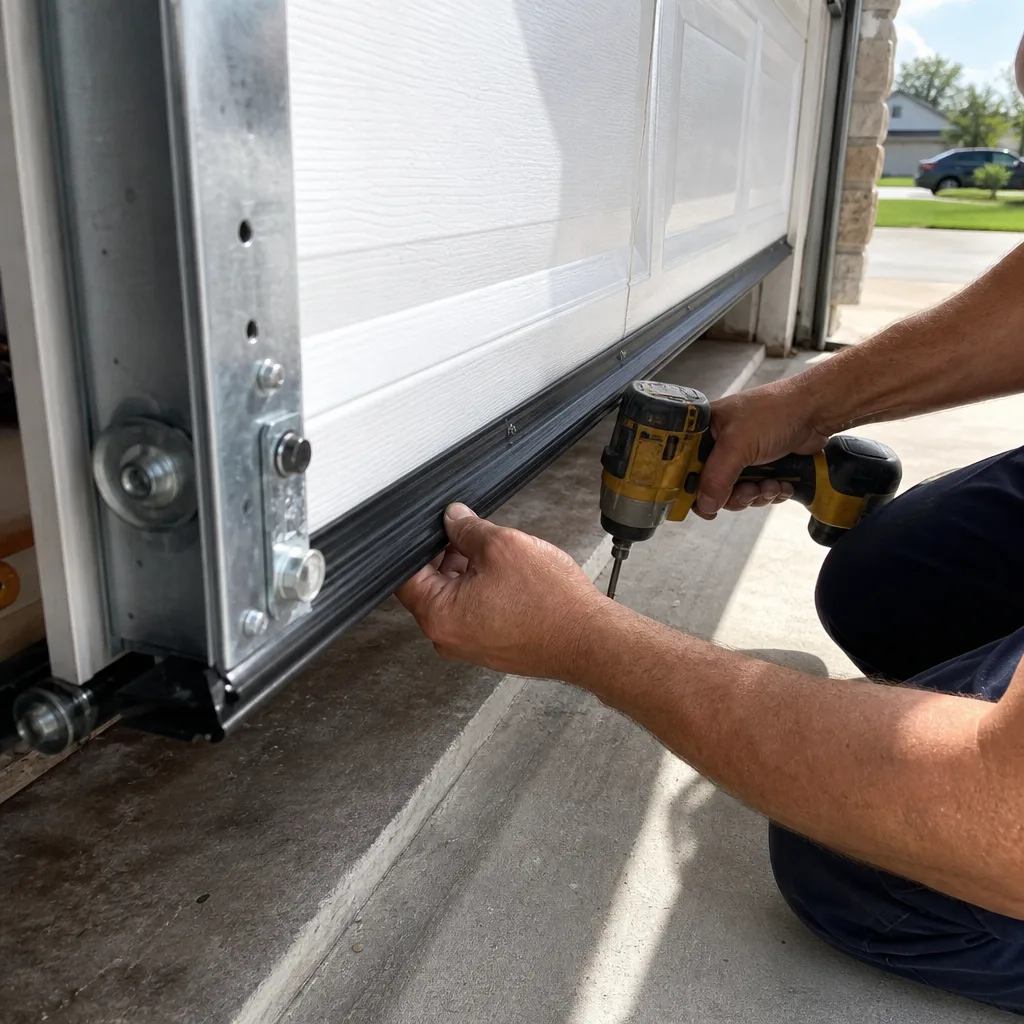
Wood garage doors are common in Tampa’s older neighborhoods: Seminole Heights, Palma Ceia, Hyde Park, and any home built before 1970 where the garage door is original or a wood-look replacement. Wood moves with humidity. In Tampa’s humid season, wood absorbs moisture and swells. In the dry season, roughly November through February, wood releases that moisture and contracts. The difference across a nine-foot door can be 1/4 to 3/8 of an inch in width. That’s enough to change how the door seats against the seals.
Here’s what that means in practical terms. The bottom seal along the bottom edge of the door, and the side seals along the door jambs, are sized to contact the door when the door is at its summertime dimensions. When the door contracts in winter, gaps open. Cold air and pests get in. But here’s the part most homeowners miss: the seal itself is not the failure. The seal is the same piece of rubber that was installed in July. The door is the component that changed size.
If you inspect the seal in winter and see a gap, the temptation is to think the seal failed. It didn’t. If you replace the seal in winter to close the gap, you’ll find the replacement seal is now too tight in summer, when the door swells back to its humid-season dimensions. That’s the trap.
How to check for dry-season contraction properly:
- Measure the gap, don’t just look at it. Use a wooden shim or a feeler dial. Note the gap width at the bottom corners and mid-point.
- Compare against the door’s summer dimensions. If the door is wood and the gap appeared when relative humidity dropped below 60 percent, the door contracted. The seal is still doing its job; the door changed.
- Check the door’s panel joints. On a wood door, the panels are built up from individual planks. Dry-season contraction opens hairline joints between planks. Paint those joints to prevent moisture entry during the next humid season. Do not caulk them: caulk prevents the wood from swelling and causes permanent warping.
- Check the side jambs for daylight. If you can see daylight along the sides, note where. Those gaps correspond to the door’s contraction points. A tapered seal strip, installed correctly, can close them without over-compressing in summer.
The practical takeaway for Tampa wood-door owners: inspect your seals in both February and August. What looks like a seal failure in February may be a door-tolerance issue, not a rubber issue. And the fix is a measured adjustment, not a part replacement.
Common Mistakes to Avoid
- Lubricating the track to fix a noisy door. The track isn’t a lubrication surface. Noise comes from rollers, hinges, or springs. Oiling the track attracts Tampa’s dust and grit into a grinding paste, and then the rollers wear out faster. The fix for noise is identifying the component making it.
- Running the door immediately after a hurricane without inspecting it. The first operation is when a storm-weakened cable or spring gives way. Follow the post-storm sequence above before pressing the button.
- Replacing the bottom seal in winter without checking the door’s contraction. On wood doors, winter gaps are usually door movement, not seal failure. A summer-installed seal will be too tight in August.
- Ignoring a door that only binds in the afternoon. Thermal binding that goes unchecked wears the rollers and the track. What started as a clearance adjustment becomes a roller-and-track replacement.
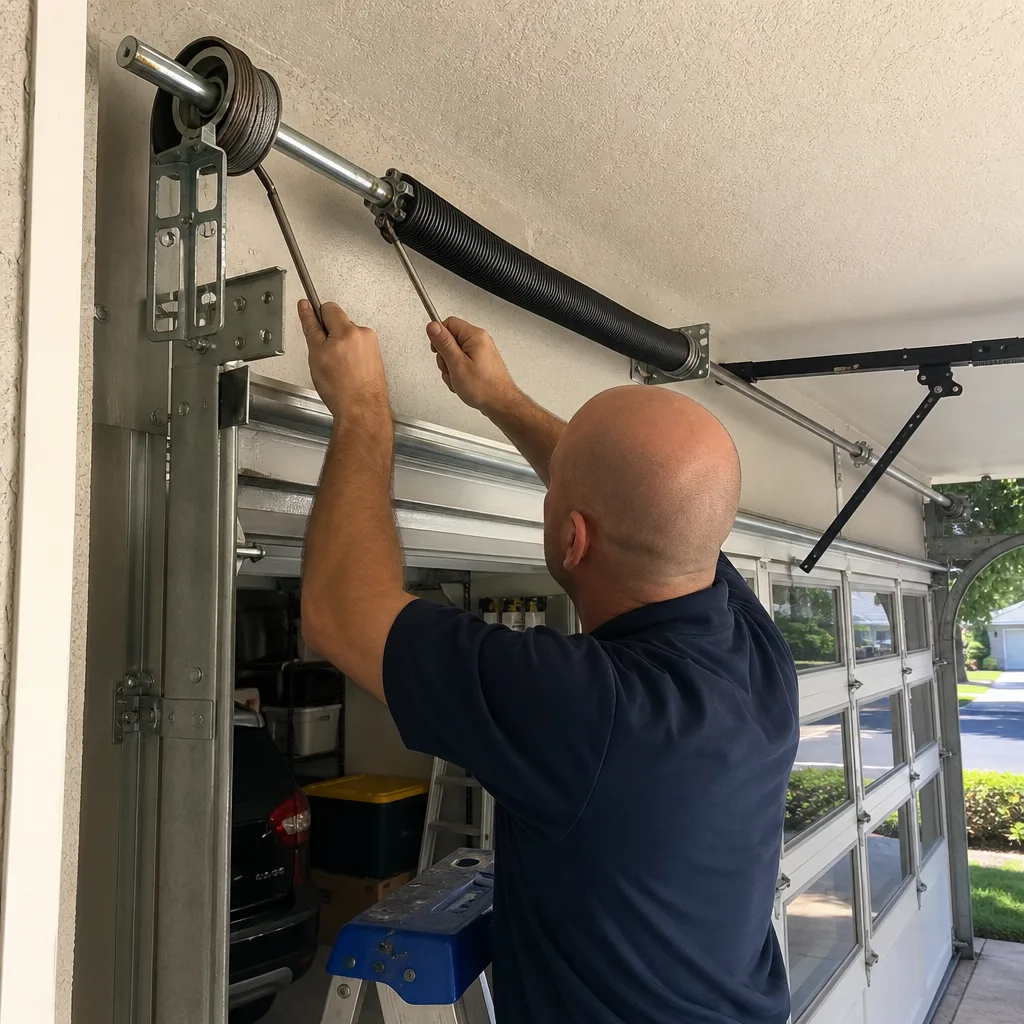
- Tightening torsion spring set screws without training. The torsion spring is under enough tension to cause severe injury. Set screws require a specific torque, and the spring must be unloaded before the screws are safely addressed. This is a professional repair, not a homeowner task.
- Skipping the pre-storm audit because the door “works fine.” The hardware that fails in a storm is the hardware that never fails under daily use. Set screws, lag bolts, and cable drums don’t announce their condition until they’re under wind load.
- Buying a replacement part online without knowing the installed dimensions. Springs, cables, and drums are sized to the door’s weight, height, and track radius. A spring that’s “close enough” either won’t balance the door or will put excessive load on the opener. Measure twice, order once.
When to Call a Professional
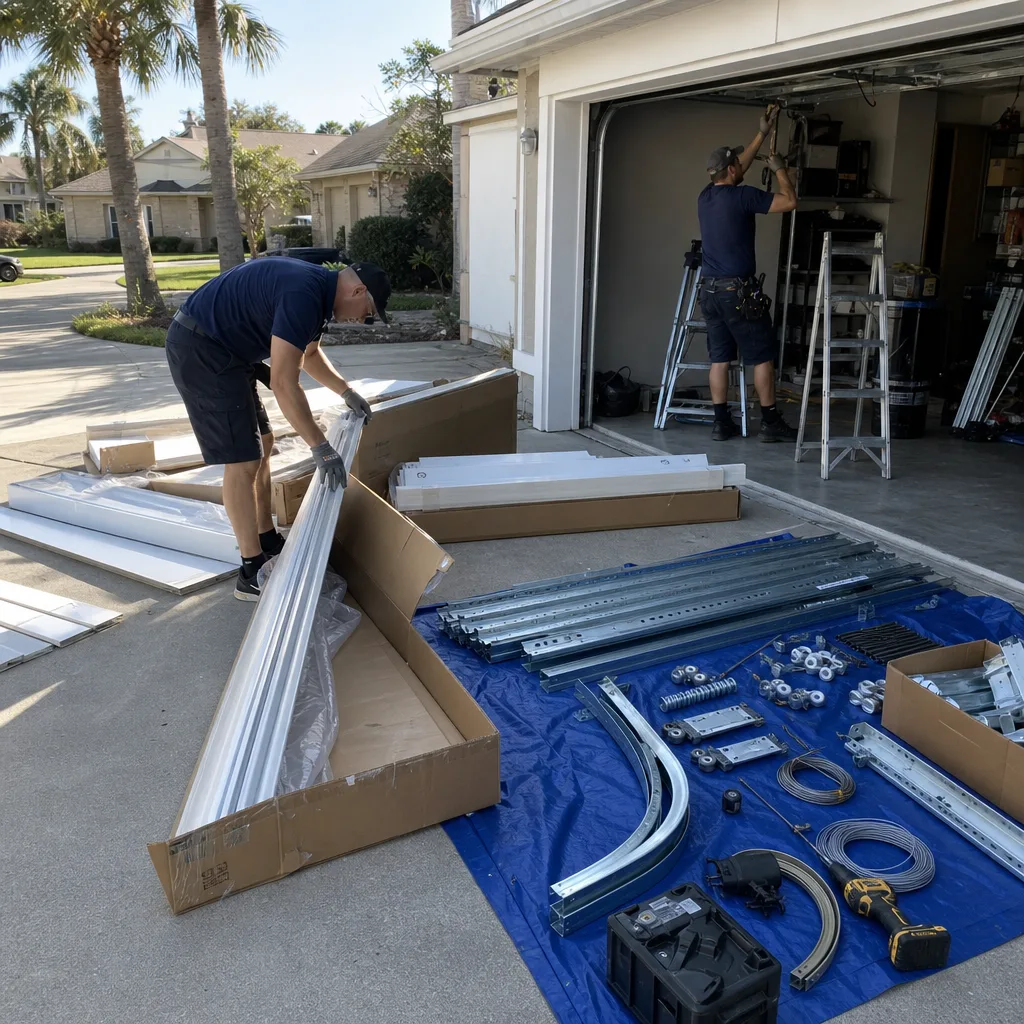
Some garage door work is homeowner territory: lubricating hinges, checking bottom seals, inspecting for visible panel damage, measuring gaps with a straightedge. Some is not. Any task that involves the torsion spring, the lifting cables, the cable drums, or the track brackets under tension is professional work. The stored energy in a torsion spring is enough to break bones or worse. That’s not a caution, that’s physics.
If your pre-storm audit reveals a loose set screw, a frayed cable, or a lag bolt that spins in the jamb, call before the storm, not after. We do free estimates in Tampa. Every job we quote includes a flat, written price and a written scope before any work starts, per Clause 1 of The Haven Standard. Servo Garage Doors Tampa offers free estimates throughout Tampa. Call (656) 223-3036.
Frequently Asked Questions
In Tampa’s climate, twice a year is the minimum: a full hardware audit in May before hurricane season and a lubrication and seal check in October as the dry season begins. Homes within three miles of the bay should add a third check in August for salt-air corrosion. Each check should include visual inspection, balance test, and fastener tightening, and each should end with a written or photographed record of what was checked.
Seasonal inspection and lubrication in Tampa typically runs $89 to $150 for a single door, depending on whether it includes balance testing and a documented report. Repairs found during an audit are quoted separately, with a flat written price before any work starts. Servo Garage Doors Tampa provides free estimates. Call (656) 223-3036 for an exact price on your specific door.
Lubricating hinges and rollers is manageable for a homeowner, provided you use dry lithium or silicone spray, not WD-40 or heavy grease. The torsion spring is a different matter: lubricating it requires reaching the spring, which is under tension. If you’re not comfortable working near the spring, or if you’d rather have a technician document the entire door’s condition at the same time, include lubrication as part of a professional garage door tune-up in Tampa.
Broken torsion springs, followed by cable failures. The springs fail because pressure differentials during the storm work the coils against each other even when the door isn’t operated. The cables fail because storm debris or a misaligned panel pinches them against the drum. If your door won’t open after a storm, the spring or cable is the place to start. Both are professional repairs.
Wood expands in Tampa’s humid summers and contracts in the dry winter. The door’s width changes by 1/4 to 3/8 of an inch across a standard opening, which opens gaps at the seals. The seals haven’t failed; the door has moved. The fix is a tapered seal adjustment, not a replacement, and the installation timing matters: a seal installed in February will be too tight in August.
Measure the gap between the roller and the track wall at several points using a feeler gauge. If the gap is consistent but small, the track needs a minor adjustment. If the gap varies from point to point, or if the track shows visible wear marks where the roller has been pressing, the track or a bracket is out of alignment and may need replacement. A technician can document the measurements and show you the wear points before any work is done.
The Bottom Line
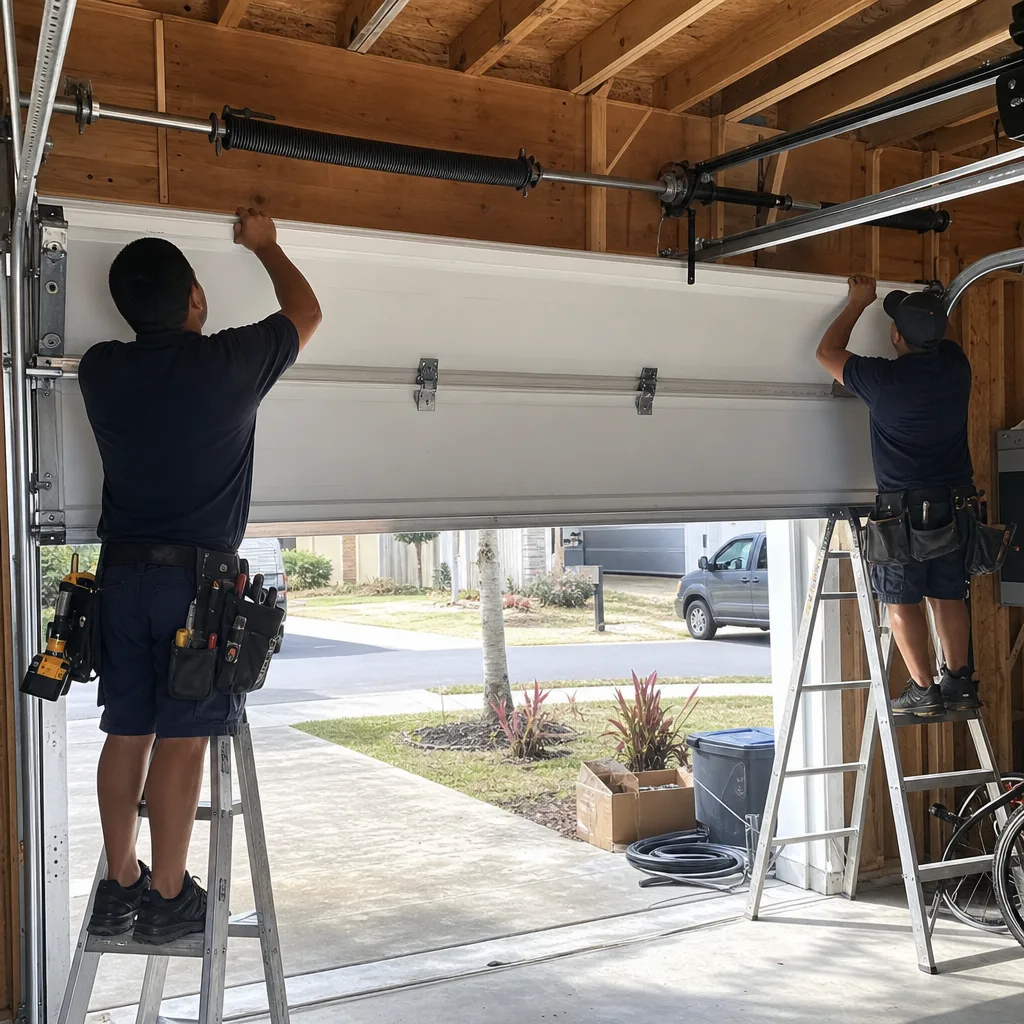
Tampa garage doors don’t fail on a seasonal schedule. They fail when a specific weather event stresses a specific component. If you audit the hardware in May, inspect before the first post-storm operation, lubricate in April with the right product, diagnose afternoon binding in summer, and measure wood-door contraction in winter, you’ll catch most failures before they happen. What you can’t see, a technician with a documented photo record can. That paper trail is what turns a guess into a repair. Servo Garage Doors Tampa has made 18,000+ garage doors right since 2015, every one with a written price before work started and a documented record when the job was done.
Call (656) 223-3036 for a free estimate, or visit our garage door installation page to see how we document every job.
Written by Marcus Deller, Owner at Servo Garage Doors Tampa, serving Tampa since 2015.